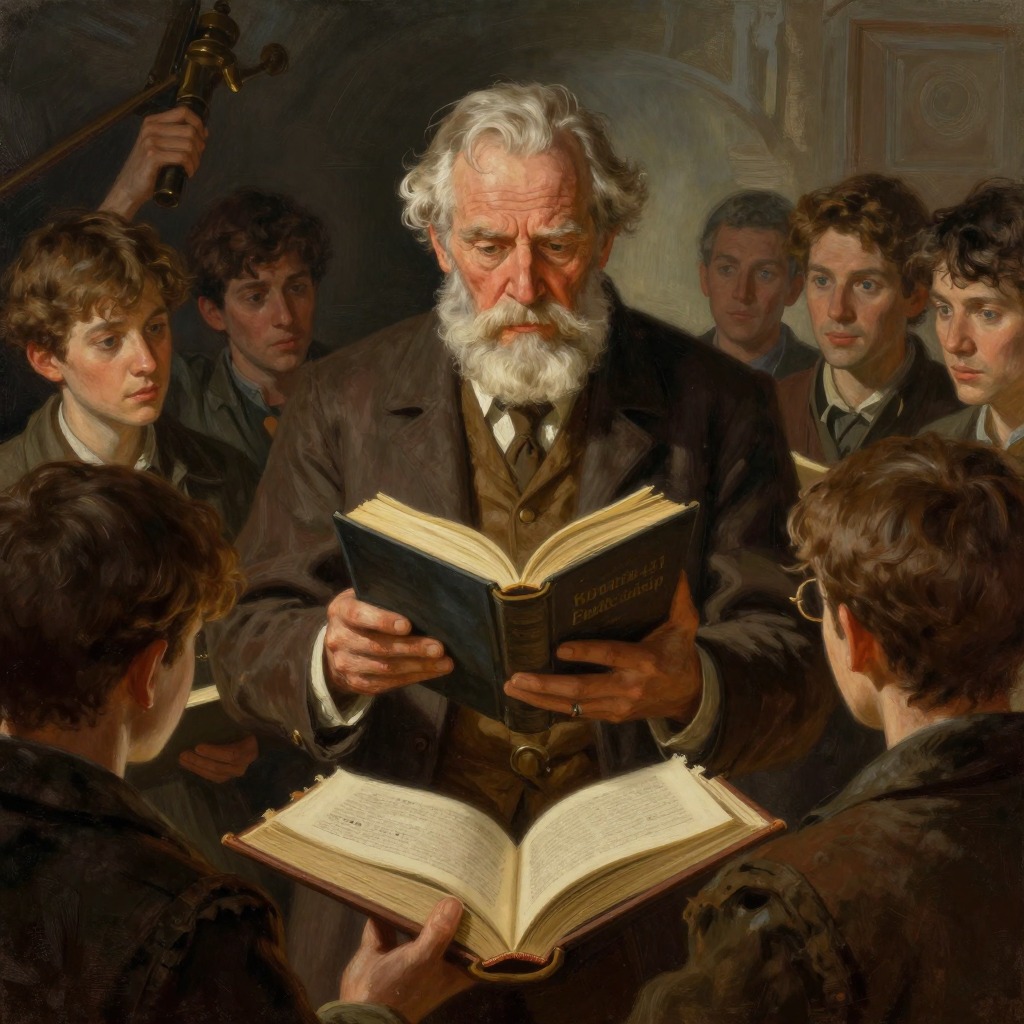
Fred Clement
Fred Clement is a minor figure in the community of wandering intellectuals that Guy Montag encounters after his escape from the city. He is introduced as a former academic who once held the Thomas Hardy chair at Cambridge University, in the years before that institution was transformed into an Atomic Engineering School. His presence among the group underscores the complete displacement of traditional humanities scholarship by a technocratic and militaristic society. Clement is one of several men who have preserved entire books in their memories, having burned the physical copies to avoid detection. When Granger introduces him to Montag, he does so by naming the intellectual tradition Clement represents: "This is Fred Clement, former occupant of the Thomas Hardy chair at Cambridge in the years before it became an Atomic Engineering School." The detail of his former position carries a heavy irony: the chair named for a novelist and poet who explored the depths of human experience has been replaced by an institution devoted to atomic engineering, a field that in the novel's world enables both the surveillance state and the war that ultimately destroys the city. Clement's role in the group is not elaborated through individual action or dialogue; he is one of the silent figures around the campfire, part of a collective that has chosen to preserve knowledge by becoming living books. His function is primarily symbolic, representing the lost world of literary and humanistic education that the society of Fahrenheit 451 has deliberately eradicated. Alongside other former professors, writers, and thinkers, Clement embodies the novel's central argument that true knowledge resides not in institutions but in the minds of individuals willing to sacrifice their comfort and safety for its preservation. His presence also reinforces the theme of memory as resistance: the group's method of memorizing texts and passing them orally from generation to generation is a direct counter to the firemen's project of erasing history. Clement, like the others, has chosen to become a "dust-jacket for a book," subordinating his individual identity to the greater task of safeguarding human culture. In the final scenes of the novel, as the group walks north along the railroad tracks after the bombing of the city, Clement is part of the silent procession, a living repository of the literature and philosophy that the firemen tried to destroy. His character, though barely sketched, contributes to the novel's hopeful conclusion: that even in the aftermath of catastrophe, the knowledge carried by people like Clement can be the seed of renewal.